
Why Should Westerners Read the Rāmāyana?
What do we owe our families? What does it cost to keep a promise? Three thousand years before these questions felt modern, the Rāmāyana was already asking them — through gods, demons, and a prince who gives up a throne rather than break his father’s word.
The Rāmāyana is one of India’s two great epics and one of the world’s great literary works, yet most Western readers barely know it. Unlike the Greek and Roman classics, it is rarely taught in Western schools, and its unfamiliar names, gods, and customs can make it feel remote from modern life.
It has survived for more than three thousand years because it speaks to questions that never go away: What makes a person good? What do we owe our families? What is a ruler’s responsibility? How should we act when duty conflicts with desire? What happens when power outruns self-control? And what does it mean to live with integrity?
For a Western reader, its value lies less in discovering an ancient legend than in encountering a different way of thinking about these questions. It offers a gateway into Indian civilization, a deeper feel for global art and literature, and a framework for examining universal ethics through a non-Western lens — an impact on world culture that rivals Homer or Shakespeare.
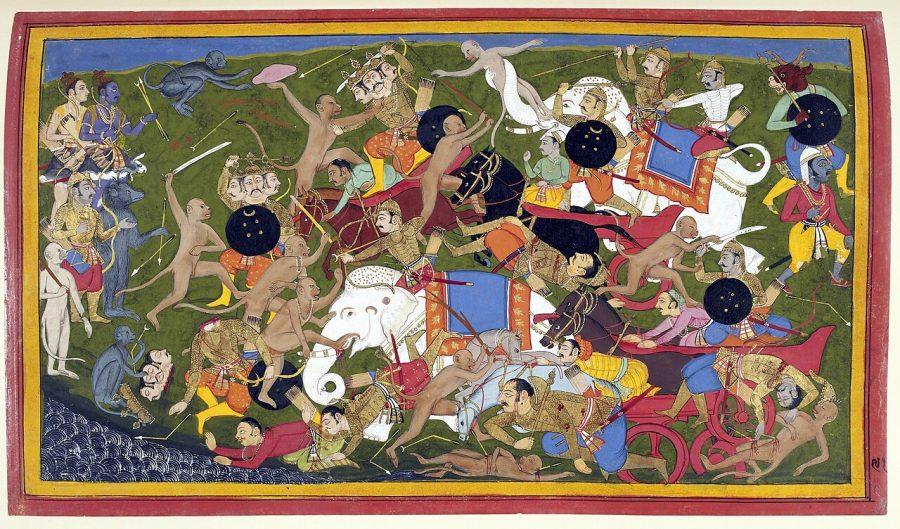
It is also, simply, a great work of fantasy: multi-headed demons, sages, flying monkeys, an enchanted golden deer, a bridge built across the ocean by animals. The narrative moves easily between lush description, political intrigue, battlefield intensity, and scenes of grief and devotion.
A Different Kind of Hero
Western literature has its great heroes, from Achilles and Odysseus to King Arthur. Rama belongs to this company but represents a different ideal. He is defined not by personal ambition but by dharma — the moral order that sustains individuals, families, and kingdoms. When his father is forced to send him into exile, Rama does not resist, though he has done nothing wrong and is about to be crowned king; he accepts it because his father’s word must be honored.
For a modern reader this can be baffling: why give up a throne for someone else’s promise? That is exactly where the Rāmāyana challenges us — asking whether a good life can be measured by happiness and freedom alone, or whether there is a different kind of greatness in sacrificing personal advantage for a principle larger than oneself.
Dharma Is Not Simply Duty
Understanding the Rāmāyana requires understanding dharma — the framework of righteous living that covers conduct, duty, law, and worship, aimed ultimately at liberation from the cycle of rebirth. Valmiki wrote the epic to portray an ideal man according to Hindu tradition, and Rama’s defining trait is that he acts according to dharma rather than self-interest.
This is clearest early on, when Rama accepts fourteen years of exile to honor a promise his father made — one relayed to him by his stepmother, Kaikeyi. His only question to her is, “Is that all you want me to do?” As he tells his brother, “Mother is like a god to us, so her words must be obeyed.” A modern reader may find this obedience unsettling, but it is the emotional center of the whole epic.
A Story About the Conflict Between Duty and Desire
Obeying dharma is not easy, which is what makes the epic relevant today. We all face the same tensions — between career and family, freedom and responsibility, ambition and integrity. Modern culture tends to prize the right to choose what is best for oneself; the Rāmāyana asks instead what we owe to others. Rama, though unaware he is an avatar of Vishnu sent to restore righteous rule, never loses sight of his ultimate purpose: to govern for the welfare of his people once his exile ends.
An Introduction to Indian Civilization
The epic is also an extraordinary introduction to Indian civilization. For generations across India and Southeast Asia, Rama, Sita, Hanuman, Lakshmana, and Ravana have been more than literary characters — they appear in religious ritual, art, sculpture, television, festival, and family life. Reading the Rāmāyana offers something a history book cannot: insight into ideals that have shaped Indian thinking about family, kingship, loyalty, marriage, courage, and righteousness.
It also explains why Diwali — the Festival of Lights, from the Sanskrit deepavali, “a row of lights” — is celebrated with such devotion: the lamps commemorate Rama’s return to Ayodhya after his victory over Ravana, the triumph of good over evil.
Gods and Human Beings Share the Same World
The Rāmāyana also offers a different relationship between the divine and the human. Gods, demons, animals, kings, and ordinary people share one narrative world, and the supernatural is not an escape from reality but a way of explaining human existence and moral order. Unlike Western epics, where mortals are often playthings of capricious gods, the Rāmāyana imagines a supreme deity incarnated as a man who must live with real grief, limitation, and moral dilemma.
For readers used to separating myth, religion, and history, this requires a shift in perspective — but a rewarding one. When a divine figure emerges from a sacrificial fire to hand a king rice pudding that will let his queens conceive sons, the useful question is not “did this happen?” but “what does this story mean to the people who have carried it for generations?” That question turns myth from a collection of fantastic tales into a civilization’s record of its deepest values.
The Characters Are More Complex Than They First Appear
The Rāmāyana is not simply good people fighting bad people. Rama, presented as an ideal man, does troubling things: he kills Vali from concealment, and his treatment of Sita after the war — sending her away to protect his reputation — raises hard questions about marriage and justice.
Ravana, meanwhile, is no cartoon villain. He is powerful, learned, and deeply versed in sacred texts; his subjects are content and his generals willing to die for him. What destroys him is not weakness but his inability to master his own desire. Had he used his power for dharma rather than adharma, he might have been the greatest king on earth.
This complexity is what makes the epic worth reading — its characters don’t behave as we expect, and the poem asks us to weigh the values behind their choices rather than simply judge them.
It Challenges Western Individualism
Perhaps the strongest reason for a Westerner to read the Rāmāyana is that it offers a counterweight to the individualism at the center of modern Western life. Individual freedom is one of the great achievements of the modern West, but if personal choice becomes the sole measure of a good life, it can crowd out our obligations to family, community, and future generations.
The Rāmāyana insists that our life is bound up with others: a ruler exists for the welfare of his people, freedom without self-control turns destructive, and even an avatar of Vishnu is not exempt from karma — a point Rama concedes when the dying Vali confronts him over his killing. Lakshmana’s own choice to leave his wife for fourteen years to serve his brother in exile is offered as an ideal of brotherly love over comfort. None of this requires a Western reader to agree with these values — only to take them seriously enough to examine their own assumptions against them.
It Raises Questions That Have No Easy Answers
Great literature makes us think, and the Rāmāyana raises hard questions about loyalty, justice, sacrifice, power, marriage, and what individuals owe society:
Was Rama right to obey his father’s command?
Why didn’t Rama negotiate peace between Vali and Sugriva, and ask for Vali’s help, who was more capable?
Do you condone Vibhishana’s defection in Ravana’s time of need?
Was Rama justified in placing his kingdom’s reputation above his personal relationship with his wife?
These questions have generated debate for centuries. A Western reader doesn’t have to accept the traditional answers — but pondering them is part of the value of reading the epic. The important thing is to understand the world of the story before judging it.
East Is East and West Is West
Does reading the Rāmāyana support Kipling’s famous line — “East is East, and West is West, and never the twain shall meet”? Three things suggest otherwise.
- Narrative kinship. The Iliad and the Odyssey share the Rāmāyana’s basic shape — a hero’s exile, a wife’s fidelity tested, a war fought over abduction and honor, a long journey home. That kinship undercuts the idea that East and West have nothing in common: the twain have always told the same kind of story.
- Internal plurality. The Rāmāyana is not a single undifferentiated “East” — mystical, static, passive. It is full of moral argument: four very different brothers, women who advise and challenge the men around them, and episodes that resist easy judgment (Dasharatha crowning Rama while his other sons are away, Ahalya’s encounter with Indra, Sita’s suspicion of Lakshmana’s motives, Mandodari’s love for a husband she knows to be flawed). Add centuries of regional retellings, and the text is too plural to flatten into stereotype.
- Boundary-crossing as theme. The plot itself crosses supposedly unbridgeable lines — Rama’s alliance with the tribal chief Guha, with a vulture, with an army of vanaras — to accomplish something greater than any one of them could alone. It is, in effect, an answer from inside the “East” to Kipling’s own claim that two strong men can meet as equals “though they come from the ends of the earth.”
The end of Rudyard Kipling’s “The Ballad of East and West” reads “there is neither East nor West… When two strong men stand face to face.” It argues that cultural barriers, geographic borders, and external differences dissolve when people meet on the shared ground of honor, virtue, and character. For a Western reader versed in Homer’s Iliad or Shakespearean drama, The Rāmāyana is an invitation to stand “face to face” with one of the foundational pillars of Eastern storytelling. By engaging with its themes, you realize that despite the vastly different cultural landscape, the core human values it explores are universal. Just as the British officer and the Afghan rebel recognize nobility in one another in Kipling’s poem, a reader from any background can recognize and respect the moral integrity of the characters in the Indian epic. Even in victory, Rama commands that Ravana be treated with a suitable burial of a king, a dignified hero, mirroring the mutual respect found at the end of Kipling’s ballad.
A Bridge Between Two Civilizations
Western readers already know the great stories of Greece, Rome, the Bible, and medieval Europe. The Rāmāyana shows that people separated by geography, language, and thousands of years have wrestled with the same fundamental questions — even when they answer them differently. Reading it is a way of understanding both worlds at once.
Global Art, Architecture, and Transnational Culture
For a Westerner traveling in Asia or exploring world art, the Rāmāyana is an essential key. Its narrative is carved into the walls of Angkor Wat in Cambodia and Prambanan in Indonesia, and it forms the backbone of classical performance across the region — Balinese Kecak, Javanese shadow puppetry, Thai ballet. Its reach beyond India is enormous: Thailand’s Ramakien, Indonesia’s Kakawin Rāmāyana, and versions across Cambodia, Laos, and Myanmar make it as foundational to Southeast Asia as Homer is to Europe. Knowing the story turns these performances and monuments from exotic spectacles into legible narrative.
Access to the Mindset of Modern India
Today’s global economy makes this more than an academic exercise: knowing the customs and beliefs of a person means understanding the epics they carry with them. Understanding modern India also means understanding Rama. Its ideals of a just society and ethical leadership still shape Indian political discourse, cinema, and everyday morality — “Ram Rajya,” Rama’s reign, has served as shorthand for good governance in Indian politics for over a century. It surfaces in ritual as much as recitation: Diwali, names given to children, proverbs, comic books, television. It remains a shared reference point.
Concluding Summary
The Rāmāyana is one of two epics — with the Mahabharata — that shape how a fifth of humanity thinks about duty, family, and right action; reading it is a shortcut to understanding Hindu, Buddhist, and Southeast Asian culture from the inside, rather than through secondhand summary.
It also simply works as literature: a tightly built adventure with a clear arc, and an accessible entry point into Sanskrit epic. Its moral questions — exile, the banishment of Sita, dharma over happiness — are genuinely unresolved, and that ambiguity is worth sitting with rather than resolving. Read next to the Iliad, where glory and individual honor are the highest values, the contrast sharpens exactly what is distinctive about the Western tradition, and about the Rāmāyana’s alternative.
The simplest reason to read it, though, is that it is a great story with something unfamiliar to say about being human. Enter its world on its own terms before judging it by modern Western assumptions — understand its values, its imagination, its conception of dharma — and then ask what you accept, what you question, and what it might mean for your own life.
Want to explore the Rāmāyana further?
The Rāmāyana for Western Readers: The Legend behind Diwali retells the ancient epic while providing the cultural and mythological context that can help readers unfamiliar with the Indian tradition enter its world.
About Debu Majumdar
Debu Majumdar is the author of The Rāmāyana for Western Readers, What Did the Buddha Teach?, Sacred River: A Himalayan Journey, Night Jasmine Tree, and the Viku children’s books. Please click below to know more about him.
