
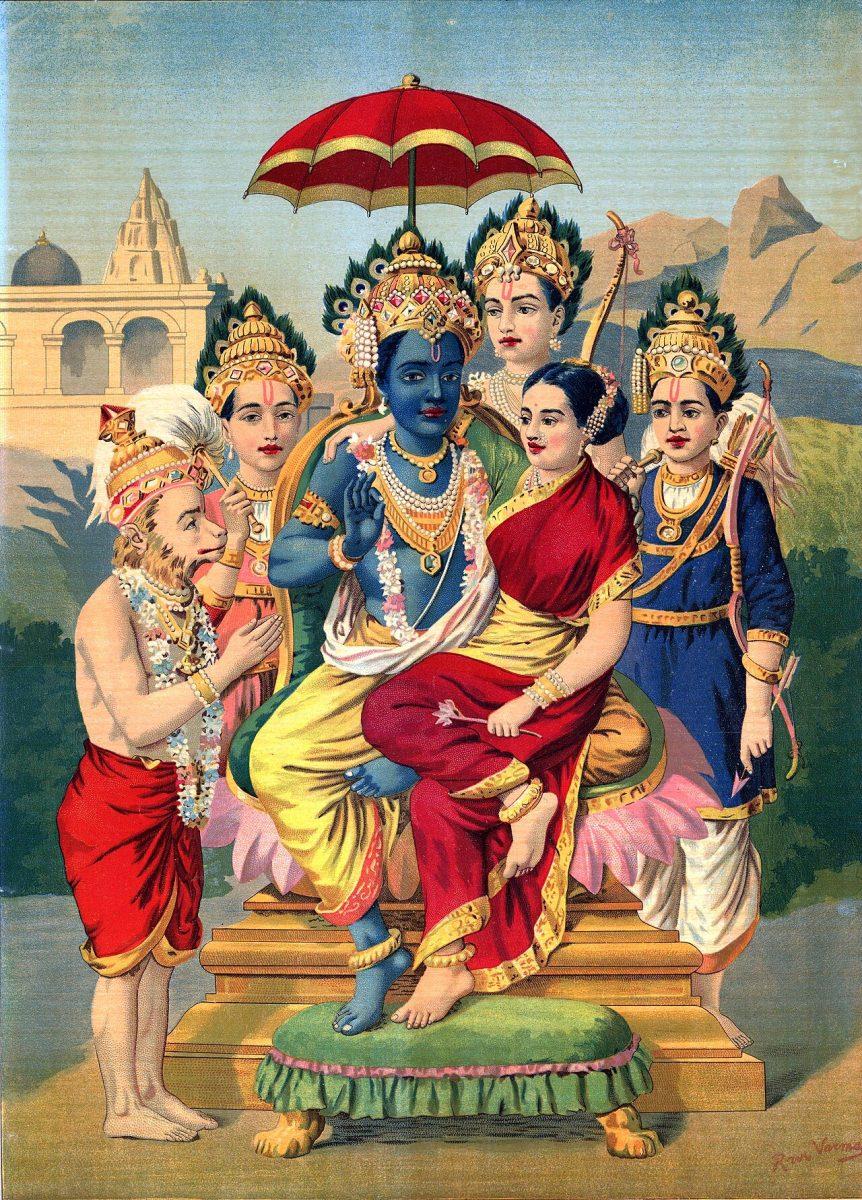
Rama as an Ideal King and his Governance of a Country
The choices Rama makes, and the ones the Ramayana holds up for scrutiny, speak directly to the leadership vacuum many people feel today.
Ram-rajya
Valmiki wrote the Ramayana for the explicit purpose of describing the life of an ideal man, Rama, whose behavior and conducts people should emulate. Rama did not display supernatural power, but always followed the Dharma with unwavering dedication, even at the sacrifice of his personal desires and happiness. He devoted his life to ruling the kingdom for the welfare of his subjects. He was a just and virtuous king and the people of the Kosala Kingdom likewise became just and virtuous. Every citizen was valued and treated with equal respect. Everyone followed Dharma and the kingdom became peaceful and prosperous. The people lived in such harmony with nature that even the wild animals were gentle with them. It was a golden age. Centuries later, this good governance of the kingdom came to be known as ‘Ram-rajya.’
Rama’s Governance
The core ingredients of this governance were: (1) righteousness prevailed in the social and cosmic order, (2) unbiased justice, transparency, and truthfulness, ensuring everyone is treated equally, (3) upholding and abiding by the promises made to the people, and finally, (4) diligently following the idea that power is a moral obligation, not a tool for dominance. Rama actively fought against tyranny and safeguarded oppressed communities. He sent his brother to kill tyrannical Lavana, Ravana’s nephew in Mathura. He demonstrated humility from the beginning by forming alliances and deep friendships across all strata of society, including tribals (Guha became his friend and an ally), sages (Viswamitra, Bharadwaja, Agastya), Vulture Jataka, and the Vanaras (such as Hanuman and Sugriva). Finally, he engaged in open dialogue with his council, brothers, and allies before making decisions.
Personal Sacrifice
One striking element of his life is that he sacrificed his personal interests and happiness for his subjects. He sent his wife to exile when he found that his subjects were doubting his wife’s chastity. He said, “I cannot punish all my subjects. A king’s duty is to keep his subjects in peace and contentment. But neither can I rule while my subjects do not respect my wife.” Rāma never took another wife. He devoted his life to ruling the kingdom for the welfare of his subjects.
Modern Implications of Rama’s Governance
Going beyond the religious aspects of the Ramayana, his principles can be interpreted now as (1) Ram-rajya represents a welfare state where the government ensures basic needs are met for every citizen. (2) Just as Rama formed alliances with the forest dwellers (Vanaras) and marginalized segments of society (such as tribal community of Guha), modern Ram-rajya demands policy focus on vulnerable communities, ensuring economic and social equity. (3) Mandates of Dharma can be interpreted as binding everyone to the absolute supremacy of the Constitution and the rule of law, where leaders are subject to the same laws as citizens. (4) The leaders must practice self-restraint and act as a trustee of public wealth, directly contrasting political corruption, nepotism, personal self-interest. (5) Rama’s willingness to listen to the feedback of his subjects—even at immense personal cost—underscores the importance of absolute accountability by strengthening channels for citizen feedback, protecting free speech, and maintaining robust public grievance mechanisms. (6) Mahatma Gandhi broadened the Ram-rajya for all faiths, rather than pushing toward a homogenous state.
Question for Modern Governance
Could this ancient ideal of governing a nation be applied to modern times? The concept of Ram-rajya—a peaceful, just, and prosperous golden age—can be translated into modern political systems as a framework for ethical, people-centric governance with its core principles aligning with democratic values, public policy goals, and human rights. The primary characteristic of Ram-rajya is the absence of fear, animosity, and societal strife. Modern political entities can view this as a mandate to foster inter-community harmony and religious tolerance, stamping out hate speech and division. Rama utilized military force only as a last resort, and even then, he strictly adhered to ethical codes of combat. In modern international relations, this mirrors a commitment to multilateralism, international law, and support of global peacekeeping.
In Summary
Ram-Rajya relies on moral duty (Dharma), self-restraint, and voluntary ethical leadership. One can think of it as a spiritually and ethically driven precursor to socialist democracy. Ram-rajya achieved a welfare-driven kingdom or society by choosing a path paved with moral obligation rather than legal compulsion, institutional state power, and secular legislation.
Want to explore the Ramayana further?
The Rāmāyana for Western Readers: The Legend behind Diwali retells the ancient epic while providing the cultural and mythological context that can help readers unfamiliar with the Indian tradition enter its world.
About Debu Majumdar
Debu Majumdar is the author of The Ramayana for Western Readers, What Did the Buddha Teach Us?, Sacred River: A Himalayan Journey, Night Jasmine Tree, and the Viku children’s books. Please click below to know more about him.
